
Parts of a CNC Router for Wood Cutting and Their Functions
Key takeaways
- A rigid frame and gantry give clean cuts at speed.
- Spindle power and vacuum hold-down decide productivity on sheet work.
- Dust collection protects the machine, the finish and the operator.
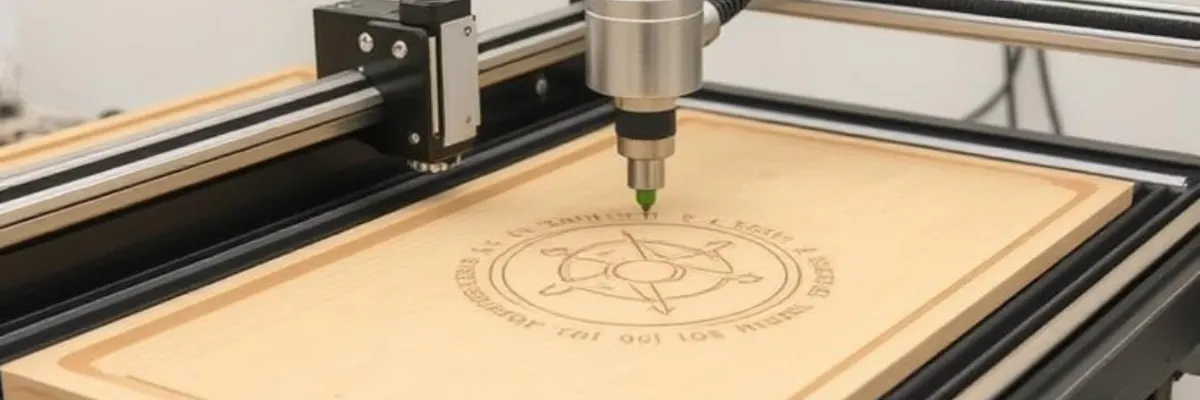
A CNC router is a powerful, programmable machine used to carve, cut, and engrave wood with speed, accuracy, and repeatability. Whether you're building cabinets, signs, or furniture components, knowing each part of your router is essential for proper operation, maintenance, and upgrades.
Here's a complete breakdown of the key components of a CNC router for wood and what they do.
1. Frame & Base
Function: Provides a rigid foundation that supports all components and absorbs vibration.
Key Features:
- Made of steel, aluminum, or composite extrusions.
- May include a torsion-box design for rigidity.
- Often supports the wasteboard and motion rails.
2. Gantry
Function: Travels across the X-axis, carrying the spindle along the Y- and Z-axes.
Key Features:
- Mounted on linear rails or V-groove wheels.
- Must be rigid to resist deflection during fast cutting.
3. Linear Motion System
Function: Enables smooth, accurate motion across all axes (X, Y, Z).
Components:
- Guide Rails & Bearings: Reduce friction, guide movement.
- Ball Screws or Rack & Pinion Drives: Convert motor rotation into precise linear motion.
4. Drive Motors & Drives
Function: Power motion on all axes and the spindle.
Types:
- Stepper Motors: Budget-friendly, accurate enough for light-duty woodwork.
- Servo Motors: Closed-loop, more accurate, higher torque—used in industrial systems.
Drives/Amplifiers: Translate controller signals into motion and manage motor current.
5. Spindle or Router Motor
Function: Spins the cutting bit to remove wood material.
Details:
- RPM range: 8,000–24,000+
- Types: Air- or water-cooled spindles, or commercial-grade router motors (e.g., Dewalt, Makita).
6. Z-Axis Assembly & Spindle Mount
Function: Controls the vertical motion of the spindle (Z-axis).
Includes:
- Z-Carriage/Quill: Slides the spindle up and down.
- Spindle Mount: Secures the spindle body.
- Collet or Drawbar: Holds the cutting bit in place.
7. Worktable & Wasteboard
Function: Supports your workpiece during cutting.
Types:
- T-Slot Table: Allows clamping at various positions.
- Vacuum Table: Uses suction to hold flat sheet material securely.
- Wasteboard: A sacrificial layer, typically MDF, that you can cut into without damaging the machine.
8. Workholding System
Function: Keeps the material in place during operation.
Options:
- Clamps & T-slot nuts
- Vacuum pods or full tables
- Screw or tape hold-downs for irregular shapes
9. Control Electronics & CNC Controller
Function: Directs machine movement and executes G-code instructions.
Components:
- Controller Unit: Interprets CAM data into motor motion.
- Breakout Board: Connects motors, switches, and sensors to the controller.
- Control Panel or Pendant: Offers jogging, E-stop, and speed control.
10. Software & Interface
Function: Generates and transfers toolpaths to the router.
Key Software:
- CAD/CAM Software: VCarve, Aspire, Fusion 360, Carbide Create.
- Control Software: Mach3/4, UCCNC, GRBL, LinuxCNC.
- Connection Types: USB, Ethernet, or wireless depending on controller.
11. Dust Collection System
Function: Removes chips and dust for cleaner cuts and better air quality.
Parts:
- Dust Shoe or Brush Hood: Mounted to spindle, surrounds the bit.
- Dust Collector/Vacuum: Pulls debris into a bin or filtration system.
Tip: Effective dust collection improves tool life and surface finish.
12. Limit Switches & Home Sensors
Function: Define machine travel limits and establish homing points.
Features:
- Located at axis ends.
- Mechanical, optical, or magnetic types.
- Prevents overtravel and crashes.
13. Cable Management
Function: Protects and organizes wires, keeping them safe during gantry movement.
Includes:
- Drag Chains (Energy Chains)
- Flexible Conduit Tubes
- Strain Relief Clips
14. Safety Features
Function: Protects operator and equipment.
Common Add-ons:
- Emergency Stop Buttons
- Limit Interlocks on doors/covers
- Safety enclosures (especially for schools or training centers)
Quick Component Table
| Component | Primary Function |
|---|---|
| Frame & Base | Structural support, absorbs vibration |
| Gantry | Moves across X-axis, carries the spindle |
| Linear Motion System | Enables X/Y/Z travel |
| Motors & Drives | Power axis and spindle movement |
| Spindle | Rotates cutting bit |
| Z-Axis Assembly | Controls vertical tool motion |
| Table & Wasteboard | Holds material, absorbs through-cuts |
| Workholding | Secures material (clamps, vacuum, screws) |
| Controller & Electronics | Reads G-code, commands motors |
| Software Suite | Generates toolpaths and interfaces with hardware |
| Dust Collection | Extracts chips/dust from cutting area |
| Limit Switches | Sets home and travel limits |
| Cable Management | Protects wiring during motion |
| Safety Equipment | Protects users and equipment |
Need a machine for this?
Tell us your part, material and quantity. We will suggest suitable new and used machines with prices.
Questions about this topic
What spindle power does a wood CNC router need?
For furniture panels and MDF, routers commonly use spindles of several kW; heavier nesting work needs more.
What is a vacuum table?
A worktable that holds sheets down with suction so they do not move during cutting.
Does CNC Online supply CNC routers?
CNC routers can be sourced on request – send your sheet size and materials.
Machines related to this guide
No machines match these filters. Tell us what you need and we will find one.
Talk to a CNC machine specialist
Send a drawing or just the part size and quantity – we will tell you which machine fits and what it costs.