
Parts of a Vertical Machining Centre (VMC) and Their Functions

Key takeaways
- A rigid base and column give accuracy; guideways and ball screws give smooth, precise motion.
- The spindle and tool changer decide speed, power and cycle time.
- Most CNC VMCs have a fixed bed – the knee belongs to knee-type mills.
A Vertical Milling Center (VMC) is the backbone of many precision manufacturing operations. To operate or maintain one effectively, it’s critical to understand its main components and their roles in machining accuracy, rigidity, and automation.
Below is a breakdown of the core parts of a vertical milling center and what each one does.
1. Base
Function:
- The foundation of the entire machine.
- Absorbs vibration and supports all structural components.
Key Features:
- Houses the coolant tank, chip collection trough, and may support leveling pads.
2. Column
Function:
- The vertical structure that supports the spindle head and knee.
- Ensures rigidity and vertical alignment.
Key Features:
- Made from heavy cast iron.
- Bolted or cast directly to the base.
3. Knee (knee-type mills only)
Most CNC vertical machining centres do not have a knee: the table and saddle move on a fixed bed and the spindle head moves up and down the column. The knee is found on conventional knee-type milling machines.
Function:
- On a knee-type mill, moves vertically along the column’s dovetail ways to raise or lower the work.
- Supports the saddle and table assembly.
Key Features:
- Heavy-duty cast section with vertical movement via lead screws or servo drives.
4. Saddle
Function:
- Slides along the Y-axis (front-to-back movement).
- Carries the table – on the knee of a knee-type mill, or on the bed of a VMC.
Key Features:
- Often includes gib adjustments for precision movement.
5. Table
Function:
- The primary workholding platform.
- Moves along the X-axis (left to right).
Key Features:
- Milled T-slots for vises, fixtures, or rotary tables.
- Can support manual or powered feed.
6. Spindle Head (Headstock)
Function:
- Houses the spindle motor, bearings, and quill.
- Delivers rotary motion to the cutting tool.
Key Features:
- May tilt or swivel for angular milling on advanced VMCs.
- Integrated with ATC (Automatic Tool Changer) on CNC versions.
7. Quill & Drawbar
Function:
- The quill allows vertical tool movement (similar to a drill press).
- The drawbar locks the toolholder in the spindle taper.
Key Features:
- Quill may be manual or power-fed.
- Drawbar system interfaces with CAT, BT, or HSK toolholders.
8. Spindle & Toolholder Interface
Function:
- Transmits spindle torque directly to the cutting tool.
Key Features:
- Accepts standardized tapers: CAT40, BT30, HSK63, etc.
- Some include through-spindle coolant ports.
9. Drive Motors & Drives
Function:
- Provide rotational motion (spindle) and linear axis movement.
Key Features:
- Spindle motor: High-torque AC or direct-drive.
- Axis motors: Typically servo motors with feedback loops.
10. Linear Guideways & Ball Screws
Function:
- Convert motor rotation into precise linear motion.
Key Features:
- Preloaded ball screws reduce backlash.
- Linear rails enable smooth, repeatable travel.
11. Automatic Tool Changer (ATC)
Function:
- Holds multiple tools and swaps them automatically.
Key Features:
- Carousel or chain-type magazine (8–40+ tools).
- Tool changes are executed mid-program.
12. Coolant System
Function:
- Delivers coolant to the cutting zone to reduce heat and flush chips.
Key Features:
- Includes a pump, nozzles, reservoir, and filters.
- Often integrated into the base.
13. CNC Control Panel
Function:
- The operator’s interface to load, monitor, and run machining programs.
Key Features:
- LCD or touchscreen display.
- Controls for manual jog, overrides, and emergency stop.
14. Enclosure & Safety Guards
Function:
- Contain chips and coolant, and prevent operator access during operation.
Key Features:
- Interlocked doors, polycarbonate viewing panels, and chip barriers.
- Required to meet workplace safety rules and CE requirements.
15. Chip Conveyor or Auger
Function:
- Automatically removes metal chips and debris from the enclosure.
Key Features:
- Screw (auger) or belt-style conveyor.
- Ejects chips into a collection bin for recycling.
Summary Table: VMC Components at a Glance
| Component | Primary Function |
|---|---|
| Base | Structural foundation, absorbs vibration |
| Column | Vertical support for head and knee |
| Knee | Z-axis vertical motion |
| Saddle | Y-axis movement; links knee to table |
| Table | Workpiece support with X-axis motion |
| Spindle Head | Houses motor and quill; provides rotation |
| Quill & Drawbar | Tool plunging and retention |
| Spindle Interface | Transfers torque to tool |
| Drive Motors | Power rotary and linear motion |
| Linear Guideways/Ballscrews | Ensure accurate axis movement |
| Automatic Tool Changer | Automates tool swapping |
| Coolant System | Controls heat and chip evacuation |
| CNC Controller | Human-machine interface for programming and operation |
| Enclosure & Guards | Operator protection and chip containment |
| Chip Conveyor | Chip evacuation and management |
Need a machine for this?
Tell us your part, material and quantity. We will suggest suitable new and used machines with prices.
Questions about this topic
Does a VMC have a knee?
Most CNC VMCs do not – the table and saddle move on a fixed bed and the spindle head moves on the column. Knees are found on knee-type mills.
What is the ATC on a VMC?
The automatic tool changer – an arm or carousel that swaps tools from the magazine into the spindle.
Which VMC parts should I check when buying used?
Spindle, ball screws, guideways, tool changer, control and the coolant and lubrication systems.
Machines related to this guide
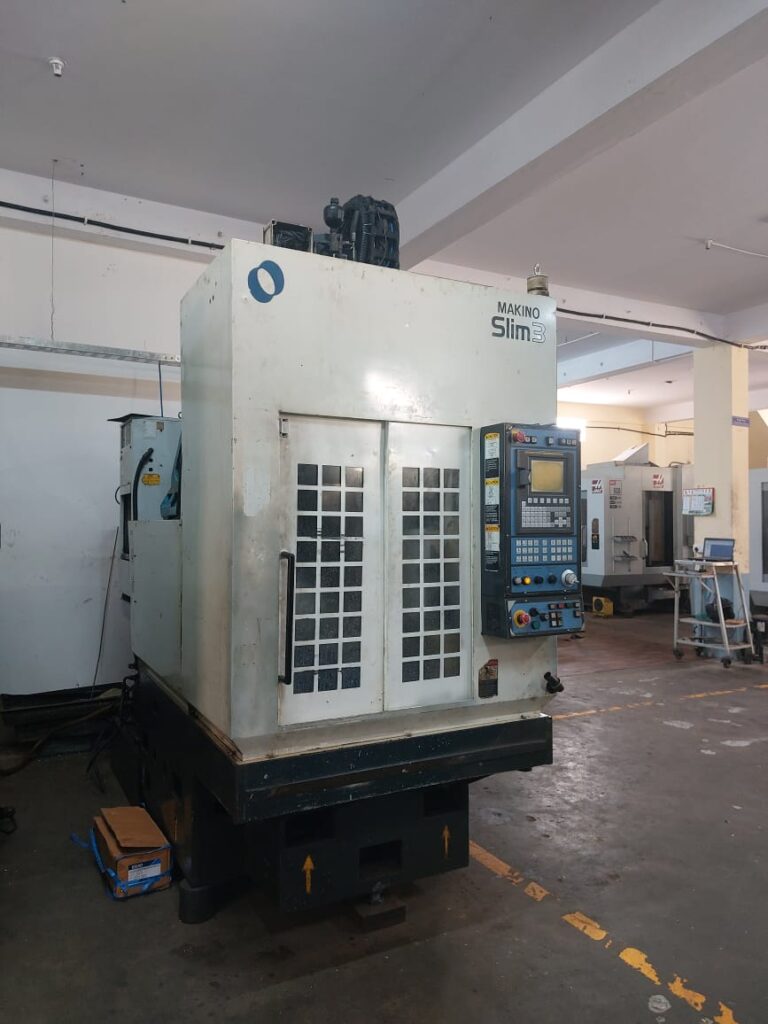
Vertical Machining Centres (VMC)
Makino Slim3 Vertical Machining Centre with 4th Axis (2008)
- Year 2008
- Control Fanuc 0i-MC
- Travel 500 / 400 / 400 mm

Vertical Machining Centres (VMC)
430 V Vertical Machining Centre
- Travel 400 / 300 / 400 mm
- Table 650 × 300 mm
- Taper BT-40
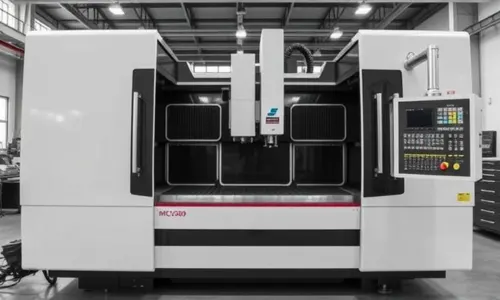
Vertical Machining Centres (VMC)
MCV300 Vertical Machining Centre
- Table 650 × 350 mm
- Travel 400 / 350 / 320 mm
- Taper 7/24 No. 40

Vertical Machining Centres (VMC)
MCV-350 Vertical Machining Centre
- Table 650 × 350 mm
- Travel 400 / 350 / 320 mm
- Taper 7 / 24 No. 40
No machines match these filters. Tell us what you need and we will find one.
Talk to a CNC machine specialist
Send a drawing or just the part size and quantity – we will tell you which machine fits and what it costs.